AI Wedding Planning: What Actually Works, What Doesn't, and How to Save 40+ Hours
The average couple spends 250+ hours planning their wedding. That's six full work weeks — spent comparing vendors, tracking RSVPs, rearranging seating charts, and chasing down details that feel endless.
Now here's the part nobody talks about: at least 40% of that time goes to repetitive logistics that a well-designed AI tool can handle in minutes. Budget categorization. Guest list filtering. Timeline scheduling. Vendor comparison matrices.
The couples who plan smarter in 2026 aren't choosing between AI and the personal touch. They're using AI to reclaim the hours they'd otherwise spend on spreadsheets — so they can spend that time on the parts of wedding planning that actually feel meaningful.
This guide breaks down exactly where AI delivers real value, where it falls short, and how to build a planning workflow that's both efficient and deeply personal.
The Real Problem: Planning Fatigue Is Killing the Joy
Here's what wedding planning looks like without structured tools:
- Week 1–4: Excitement. You're browsing Pinterest, imagining your dream day.
- Week 5–12: Reality hits. You're tracking 15 vendor quotes in a messy spreadsheet, fielding texts from relatives about dietary needs, and realizing the venue you loved is $8,000 over budget.
- Week 13–30: Burnout. The romantic excitement is gone. Planning feels like a second job. One partner starts doing all the work. Arguments follow.
A 2025 survey by The Knot found that 96% of couples reported feeling stressed during wedding planning, with budget management and guest logistics cited as the top two sources.
AI doesn't eliminate stress. But it eliminates the administrative stress — the kind that adds zero value to your celebration but consumes the most time.
Where AI Actually Delivers: The High-Impact Tasks
Not all AI tools are created equal. Here's where the technology genuinely outperforms manual planning — and where it's mostly hype.
1. Budget Management: From Spreadsheet Chaos to Real-Time Clarity
This is AI's strongest use case in wedding planning. Traditional budget tracking means a spreadsheet you update manually, forget to check, and discover three months later that you've overspent by $3,000.
AI-powered budget tools can:
- Predict total costs based on your location, season, guest count, and style preferences — before you sign a single contract
- Categorize spending automatically as you add vendors, deposits, and purchases
- Flag budget drift in real time: "You've allocated 35% to catering but the average for your guest count is 28% — here's where to rebalance"
- Surface hidden costs that 70% of couples forget: service charges, gratuities, overtime fees, setup/breakdown costs, day-of coordination
| Manual Tracking | AI-Powered Tracking |
|---|---|
| Update spreadsheet manually after each payment | Auto-categorizes transactions |
| Discover overspending weeks later | Real-time alerts when categories exceed targets |
| No benchmark data | Compares your budget against similar weddings |
| Hidden costs are surprises | Proactively surfaces commonly forgotten line items |
| 2–3 hours/month maintaining | Set up once, check dashboard anytime |
Time saved: 15–20 hours over the planning period.
2. Guest List & RSVP Intelligence
Managing 150 guests across families, friend groups, dietary needs, and table assignments is a logistics nightmare that scales exponentially.
AI streamlines this by:
- Automating RSVP follow-ups — no more individual "Hey, did you get our invite?" texts
- Clustering guests by relationship groups for balanced seating suggestions
- Tracking dietary requirements and allergies in a single dashboard that exports directly to your caterer
- Predicting attendance rates based on distance, relationship closeness, and historical RSVP patterns (yes, this exists)
Time saved: 10–15 hours for a 150-person wedding.
3. Vendor Research & Comparison
The old way: open 40 browser tabs, email 20 vendors individually, compare quotes on paper, lose track of who responded.
AI-assisted vendor matching analyzes your style, budget, date, and location to surface a shortlist of compatible vendors — ranked by fit, not just price. Some platforms even aggregate reviews and flag potential red flags automatically.
Time saved: 8–12 hours of research and comparison.
4. Timeline & Checklist Automation
A wedding timeline has 100+ tasks across 12+ months. The cognitive load of remembering what needs to happen when — and in what order — is enormous.
AI planning tools generate a personalized timeline based on your wedding date, venue type, and priorities. Tasks are sequenced with dependencies (book florist after confirming color palette, not before). Reminders are automatic. Nothing falls through the cracks.
Time saved: 5–8 hours of planning and reorganizing.
5. Design Inspiration & Mood Boards
This is where AI gets genuinely exciting. Upload a photo of your dream aesthetic — a sunset, a fabric swatch, a Pinterest screenshot — and AI tools can:
- Extract a color palette with exact hex codes
- Suggest matching flowers, linens, and decor that align with your palette
- Generate table layout visualizations optimized for your venue floor plan and guest count
- Create mood boards that you can share with vendors so everyone's aligned on the vision
This replaces hours of Pinterest scrolling with a focused, actionable design direction.
Where AI Falls Short: The Tasks That Should Stay Human
Here's where the honest guide gets honest. AI is a tool, not a replacement for the emotional core of your wedding. Some things should feel laborious, because the labor is part of the meaning.
❌ Writing Your Vows
AI can generate grammatically perfect vows in 10 seconds. They'll be generic, forgettable, and your partner will feel the difference. The stumbling, rewriting, and vulnerability of writing your own vows is the entire point.
❌ Choosing Your Music
Your first dance song, your processional, the song that makes your mom cry — these are deeply personal selections that require emotional memory, not algorithmic recommendation. Spotify's DJ mode is fine for the reception playlist. It's not fine for the moments that define your ceremony.
❌ Curating Your Guest List
Who to invite is a relationship decision, not a data decision. AI can help you manage the list you've created, but the creation itself — the difficult conversations about capacity, budget constraints, and family dynamics — requires human judgment and empathy.
❌ Designing Ceremony Rituals
Whether it's a unity candle, a sand ceremony, a tea ceremony, or a custom ritual you've invented together — this is where your wedding becomes yours. AI can suggest options, but the selection and personalization must come from your shared story.
❌ Crafting Your Love Story
Your wedding website's "Our Story" section should sound like you, not like a chatbot. The inside jokes, the awkward first date, the moment you knew — these details are what make guests smile. Write it together, even if it takes three drafts.
The Decision Matrix: AI vs. Human
| Task | Best Handled By | Why |
|---|---|---|
| Budget tracking & forecasting | 🤖 AI | Data-heavy, repetitive, error-prone manually |
| RSVP management & reminders | 🤖 AI | Scale task — 150 individual follow-ups is unsustainable |
| Vendor research & comparison | 🤖 AI | Information-dense, benefits from structured filtering |
| Timeline & task sequencing | 🤖 AI | Complex dependencies, easy to miss deadlines |
| Color palette & mood board | 🤖 AI | Pattern recognition, visual matching at scale |
| Seating arrangements | 🤖 + 👫 Both | AI generates optimized layouts, you add relationship context |
| Writing vows | 👫 Human | Emotional authenticity can't be automated |
| Choosing music | 👫 Human | Personal memory and meaning |
| Guest list decisions | 👫 Human | Relationship judgment |
| Ceremony design | 👫 Human | Cultural and personal significance |
| Love story narrative | 👫 Human | Your voice, your humor, your history |
How to Build Your AI Planning Workflow (Step by Step)
Ready to integrate AI into your planning without losing the soul of your wedding? Here's the practical workflow:
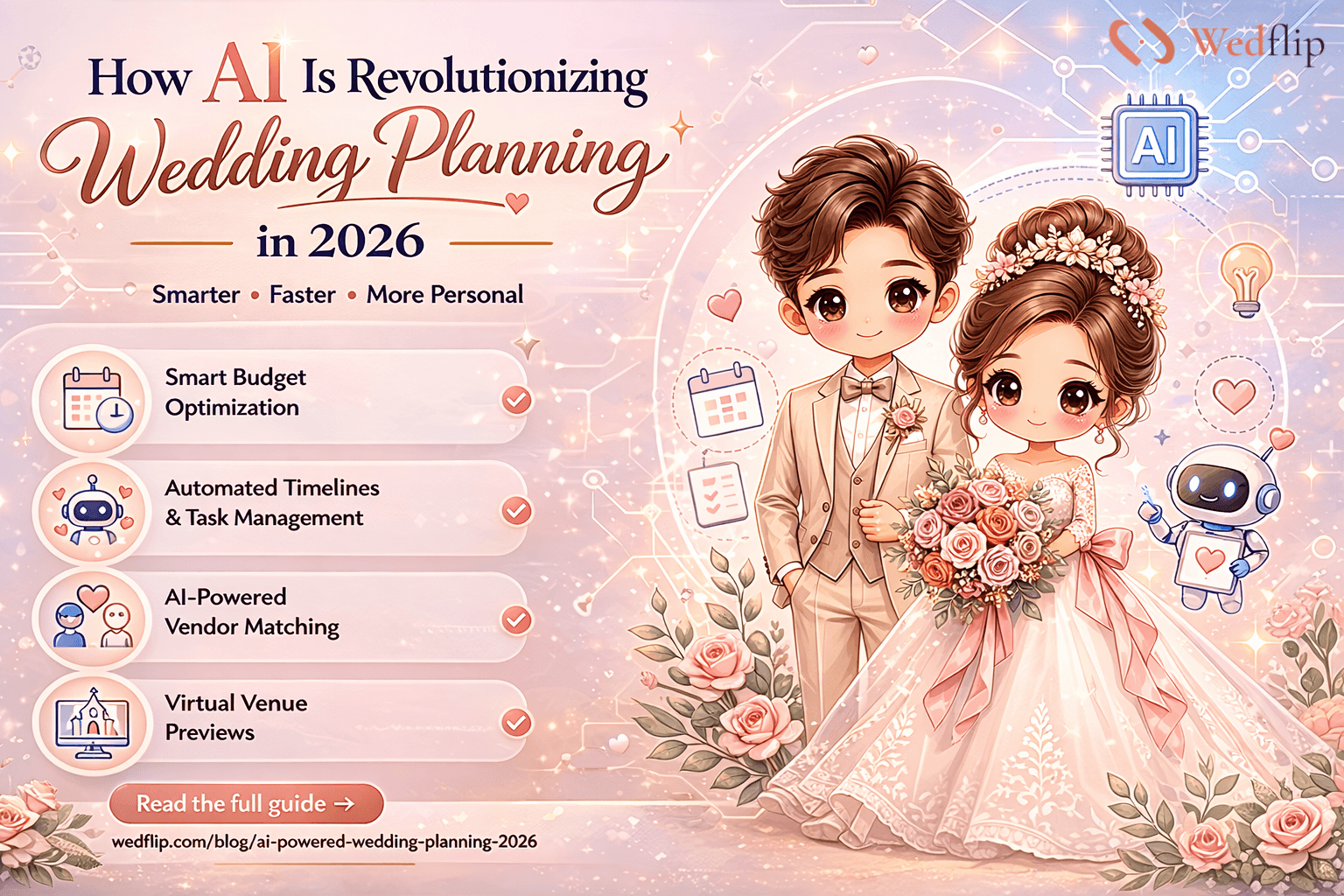
Step 1: Start with your budget. Set up an AI budget tracker before you book anything. Input your total budget, and let the tool suggest category allocations based on your guest count and location. This prevents the most common planning mistake: booking the venue before understanding the full budget picture.
Step 2: Generate your timeline. Input your wedding date and let AI create a reverse-engineered task list with deadlines. Review it once, adjust priorities, then let it run.
Step 3: Use AI for vendor shortlisting, not vendor selection. Let the algorithm surface your top 5 florists. Then meet them in person and choose based on chemistry, communication style, and gut feeling.
Step 4: Automate guest management. Send digital invitations, set up automatic RSVP tracking, and let the system handle reminders. Export the dietary report to your caterer with one click.
Step 5: Protect the human moments. Block time on your calendar — together — for vow writing, music selection, and ceremony planning. These aren't tasks to "get done." They're experiences to savor.
The Couples Who Get It Right
The happiest couples in 2026 aren't the ones who plan everything manually or the ones who automate everything. They're the ones who draw a clear line:
AI handles the logistics. We handle the love.
They spend 40 fewer hours on spreadsheets — and invest those hours in tasting cake together, arguing (lovingly) about playlist order, and writing vows that make each other cry at the altar.
That's not a compromise. That's the best of both worlds.
Start Planning Smarter — Today
Wedflip's AI planning assistant helps you build your budget, track your timeline, manage your guest list, and organize every detail — so you can focus on what actually matters.
Set up takes 3 minutes. No spreadsheets required.